
This article provides an introduction to addressable advertising for free-to-air broadcast networks using HbbTV.
Addressable advertising (also known as targeted advertising) is a method of delivering different advertising messages to different households or devices while they are watching the same TV channel or programme. Instead of every household seeing the same linear commercial, ads can be selected based on factors such as geography, household socio-demographics, interests, or viewing behaviour.

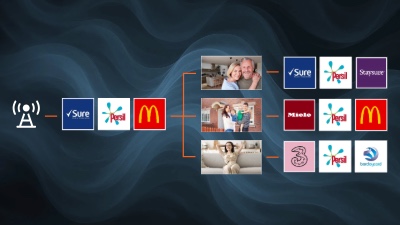
The diagram shows the ad breaks that different audience segments (retired couple, young family, single renter) might see compared to an unaddressed linear feed.
For broadcasters, addressable advertising offers:
For advertisers, it provides:
Reported results from addressable advertising include:
These figures are from AdSmart: Five Years & Forward publishing is August 2019.
For addressability, households are placed in segments which received different ads. Segments may be based on region, location or socio-demographics (e.g. life stage, income level, children, property setting). Segments can also be created using first party data from the broadcaster or advertiser (e.g. subscriptions, purchase, insurance renewal dates, tyoe of car).
There are several terms used for addressable advertising including:
The term targeted advertising is also used by some, but this term is not used by the wider advertising industry as all advertising is targeted.
In pure OTT environments, addressable advertising is relatively straightforward because the entire stream is already delivered over IP as a unicast stream which can be unique to the household. However, broadcast linear TV is inherently one-to-many and not personalised.
Addressable advertising in broadcast TV therefore relies on hybrid delivery models, that combine broadcast delivery for the main programming and an alternative mechanism for the addressed advertising. The mechanism used depends on the television environment.
Addressable advertising is sometimes confused with interactive advertising where advertising or interactivity is shown over programming or advertising content as some form of overlay, including:
Addressable advertising can be made interactive and interactive ads can be addressed.
Addressable advertising has developed over more than two decades, evolving from early technical trials into a core capability across broadcast, pay TV, and streaming environments.
One of the earliest large-scale demonstrations of addressable advertising took place in 2003–2004, when Comcast conducted commercial trials in Aurora, Colorado using its SpotOn platform. These trials were notable for enabling frame-accurate switching between multiple broadcast feeds within a multiplex, allowing different households to receive different ads within the same linear channel. Major advertisers including Coca-Cola, General Motors, Home Depot, Johnson & Johnson, and the U.S. Army participated, helping to demonstrate both the commercial viability and scalability of the approach. The trials showed that addressable advertising could improve viewer engagement, for example by reducing channel switching during ad breaks, and also introduced some of the first second-by-second reporting of TV usage, providing a new level of insight into audience behaviour.
Building on these early successes, addressable advertising moved into large-scale commercial deployment around 2012across US satellite and cable platforms, including DISH, DirecTV, and cable operators. These deployments were typically based on operator-controlled set-top boxes, enabling precise targeting, local ad storage, and tightly managed delivery. This phase established addressable advertising as a viable and scalable model within closed pay-TV ecosystems.
In the UK, Sky’s AdSmart platform marked a significant milestone in the evolution of addressable advertising in Europe. Trialled in 2013 and launched commercially in 2014 with an initial reach of around six million households, AdSmart demonstrated how addressable advertising could be deployed at scale across a multi-channel broadcast environment. Since launch, it has delivered tens of thousands of campaigns for thousands of brands across more than 100 channels. More recently, the capability has extended beyond traditional satellite delivery to IP-only devices such as Sky Glass and Sky Stream, reflecting the broader shift toward hybrid and fully IP-based distribution.
In parallel with operator-led approaches, HbbTV-based addressable advertising began to emerge in Europe at around the same time as AdSmart. Early experiments explored how hybrid broadcast-broadband technologies could enable dynamic ad insertion on connected TVs without reliance on proprietary set-top boxes. Over time, HbbTV deployments have scaled across markets including Germany, Italy, Spain and others, providing broadcasters with a standards-based route to addressability. A key development in this evolution was the publication of HbbTV-TA (Targeted Advertising) in 2020, introducing mechanisms such as MediaSwitcher to improve switching accuracy and enable more advanced ad replacement scenarios.
Alongside broadcast developments, streaming and on-demand services have also played a significant role in the evolution of addressable advertising. Some of the earliest advertising-funded streaming services incorporated dynamic ad insertion from the outset, benefiting from fully IP-based delivery. As these services have grown, the underlying technology has continued to evolve, influencing expectations around targeting, measurement, and campaign optimisation across the wider TV ecosystem.
Today, addressable advertising spans a spectrum of approaches, from tightly controlled operator environments to open, standards-based broadcast solutions and fully IP-delivered streaming services. Together, these developments have established addressability as a central component of modern television advertising, combining the reach of broadcast with the precision and accountability of digital.
Sky pioneered large-scale broadcast addressable advertising in the UK using a fully managed, operator-controlled ecosystem known as AdSmart. In the Sky DTH model:
This approach delivers excellent accuracy and scale, but it is operator-specific and not directly transferable to free-to-air or multi-platform environments.
HbbTV enables addressable advertising in free-to-air broadcast environments using open standards and broadband connectivity available on connected TVs.
Rather than relying on proprietary set-top boxes, HbbTV leverages:
This makes HbbTV particularly attractive for broadcasters seeking scalable, standards-based addressable advertising that can be deployed across free-to-air services.
Hybrid Broadcast Broadband TV (HbbTV) is an open European standard that allows broadcasters to deliver interactive and enhanced services to connected TVs by combining:
HbbTV works well for addressable advertising because:
Crucially, this allows broadcasters to retain control of the primary viewing experience while selectively introducing personalised advertising.
At a high level, HbbTV-based addressable advertising works as follows:
The broadcast channel signals that an HbbTV application is associated with it and provides a URL for that application. This information is delivered alongside the channel metadata in an Application Information Table (AIT). While multiple applications may be associated with a channel, only one HbbTV application can be active at any given time. When a viewer tunes to the channel, a HTML and JavaScript application is automatically downloaded over the broadband connection and executed on the TV. The application does not need to be visible and may have no user interface at all. If the viewer changes channel, then the HbbTV application is killed.
Shortly before an ad break (10 to 20 seconds), a signal is sent in the broadcast stream indicating exactly when the break will begin. This signal is carried in an HbbTV stream event. The stream event usually encapsulates an SCTE-35 trigger in a form that the HbbTV application can receive and process.
On receiving the trigger, the application communicates with an ad decision server (ADS). The ADS determines which ads should be replaced and what replacement ads should be shown. At the appropriate moment, the HbbTV application switches video playback from the broadcast stream to a broadband stream containing the replacement ads. Once the replacement ads have completed, the application switches playback back to the broadcast channel.
From the viewer’s perspective, this appears as a normal ad break, but the ads themselves may differ from household to household.
Addressable advertising using HbbTV can be implemented at different levels of granularity, depending on the broadcaster’s technical architecture, commercial objectives, and device support. The two primary approaches are spot-level replacement and break-level replacement, each with distinct trade-offs.

Spot-level replacement involves substituting individual advertisements within a traditional broadcast ad break. This approach offers a high degree of flexibility, allowing specific ads to be targeted while others remain unchanged. However, spot-level replacement places significant demands on timing accuracy. It typically requires either clearly defined inter-spot take-off and landing zones to mask the transition between broadcast and broadband streams, or the use of HbbTV-TA (MediaSwitcher), which enables near frame-accurate switching.
Break-level replacement takes a different approach by replacing the entire broadcast ad break with a single broadband-delivered stream. This model simplifies timing and switching, as the transition occurs only once at the start of the break and once at the end. Within the broadband stream, ads can still be personalised at a spot level. In many cases, the broadband stream may include mirrored versions of the original broadcast ads alongside targeted replacements, allowing broadcasters to retain campaign commitments while enabling addressable delivery. Because the sequencing is handled entirely within the broadband stream, break-level replacement supports back-to-back personalised ads and avoids many of the limitations associated with spot-level switching.
For many broadcasters, break-level replacement provides a more robust and scalable starting point for HbbTV-based addressable advertising. Spot level replacement can be considered if HbbTV-TA penetration reaches significant levels.
HbbTV-based addressable advertising is not always frame-accurate when switching between broadcast and broadband streams. Small timing differences can occur due to buffering, network conditions, video encoding and device behaviour.
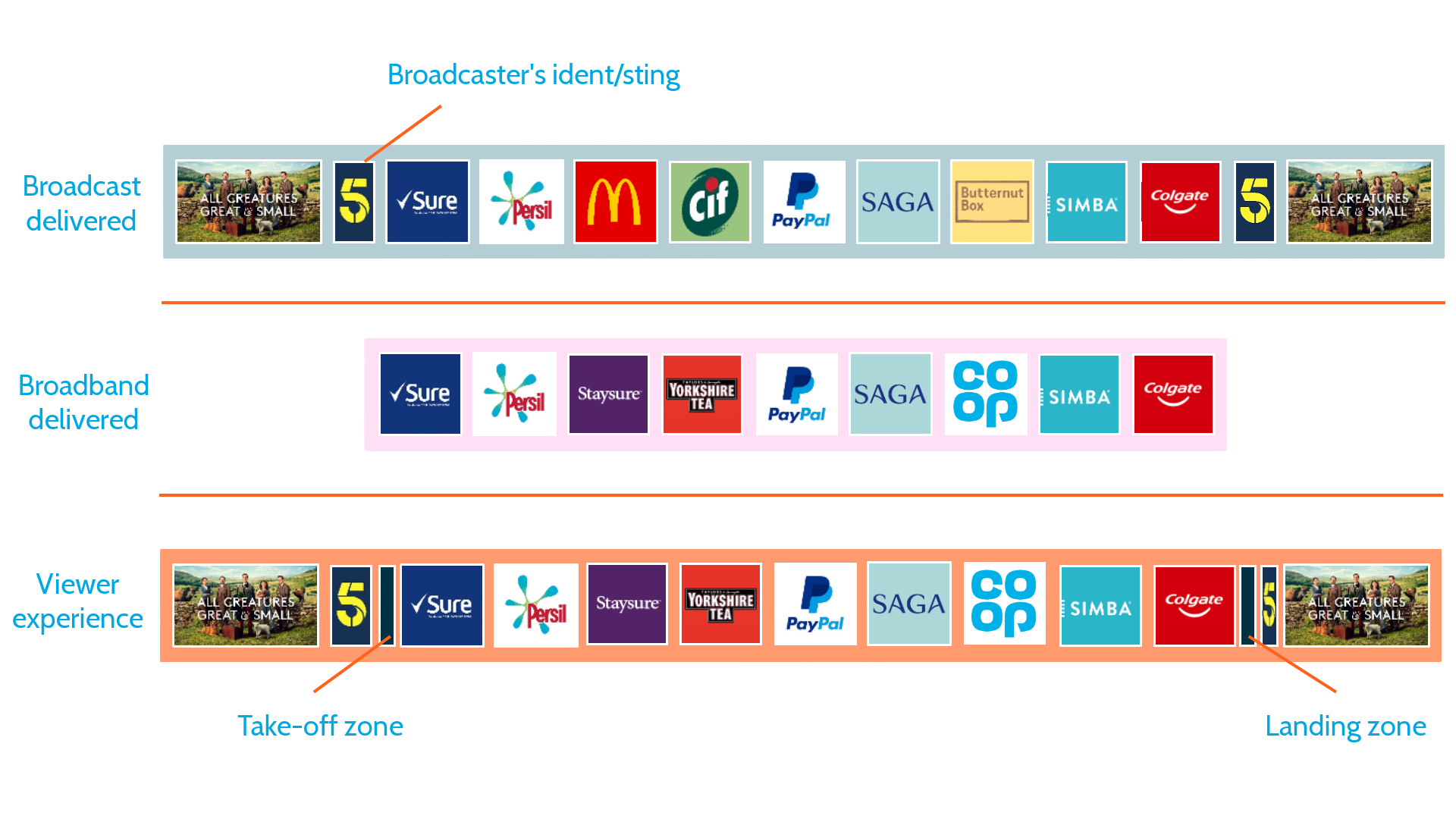
To mask these transitions, broadcasters require a take-off and landing zones, usually during short pieces of content that are neither programme nor advertising. Most commonly these are during the channel idents or branded stings.
These zones avoid ads and programming content interfering with each other when switching back and forth between broadcast and broadband video streams.
The diagram shows the viewer experience of a combined broadcast and broadband streams, with the take-off and landing zones.
In a basic implementation the take-off and landing zones include black frames while the television switches between the two video streams. In more advanced implementations these can be masked with graphics images or animations.
HbbTV-TA, often referred to as MediaSwitcher, is an extension to HbbTV designed specifically to improve ad replacement accuracy.
Key characteristics:
In practice, access to HbbTV-TA functionality by a broadcaster, usually requires a bilateral agreement between them and the TV manufacturer. Such an agreement may have commercial terms that include sharing of addressable advertising revenues.
As HbbTV-TA does not require take-off and landing zones, it can be used for spot-level replacement. However, to retain the accuracy it cannot be used to replace back-to-back ads and therefore can only replace every other ad in an ad break.
HbbTV-TA was published in 2020, its adoption had been slow and only a few manufacturers claim to support it and usually on a country specific basis. Samsung support HbbTV-TA in Italy. LG, Vestel and TP-Vision have announced support for it in Germany. It is likely a new market adopting HbbTV-TA will take several years to build up an install base. Whereas, most European countries, have high levels of deployment of standard HbbTV and the alternative to MediaSwitcher called MediaSync.
This makes HbbTV-TA highly attractive from a technical perspective, but more complex commercially and operationally.
A fundamental constraint of HbbTV is that only one application can be active at a time on a channel.
This creates challenges when broadcasters want to support multiple concurrent use cases, for example:
To address this, broadcasters must combine multiple functions into a single orchestrating application.
This is a key architectural consideration for scalable, future-proof HbbTV deployments.
Ad decisioning is the process of determining which advertisement should be shown to a specific household at a specific point in time. It sits at the heart of addressable advertising, translating campaign objectives, audience data, and delivery constraints into a real-time decision about ad selection. In a broadcast addressable environment, ad decisioning must balance precision targeting with the strict timing and operational requirements of linear television.
In HbbTV-based addressable advertising, ad decisioning is typically performed by an Ad Decision Server (ADS)accessed over broadband. When the HbbTV application receives a signal that an ad break is about to begin, it sends a request to the ADS containing contextual information such as:
The ADS evaluates this information and returns a response indicating:
Ad decisioning is governed by a set of rules that ensure campaigns are delivered effectively, comply with regulations, and maintain a high-quality viewer experience.
Capping and spacing are used to control how often a viewer sees a particular advertisement. Frequency capping limits the number of times an ad is shown to a household over a given period, while spacing rules ensure that repeat exposures are distributed over time rather than clustered too closely together. This helps prevent viewer fatigue and improves campaign effectiveness.
Clash rules prevent conflicting or competing advertisements from being shown within the same ad break or viewing session. For example, ads from competing brands or categories may be restricted from appearing together, and certain campaign combinations may be disallowed to protect brand positioning or comply with commercial agreements. These rules help ensure a coherent advertising experience for viewers while safeguarding advertiser interests and maintaining the integrity of campaign delivery.
Exclusions are applied to ensure compliance with regulatory, commercial, or brand safety requirements. These may include restrictions on showing certain categories of advertising, such as high fat, sugar and salt (HFSS) products or adult content, to specific audiences or during particular programmes. Exclusions can be applied based on content classification, time of day, or audience characteristics.
Socio-demographic and lifestyle targeting enables campaigns to be directed toward specific audience segments. These segments may be defined using attributes such as age range, household composition, affluence, or inferred interests and behaviours. The availability and granularity of this data depend on the implementation and applicable privacy frameworks, but it allows advertisers to align messaging more closely with relevant audiences.
Ad decisioning brings together campaign goals, audience data, and operational constraints to enable precise and controlled ad delivery in a broadcast environment. In HbbTV-based systems, it operates in real time alongside broadcast signalling and application logic, ensuring that addressable advertising is both effective for advertisers and seamless for viewers.
Audience and advertising measurement in traditional broadcast television has historically been focused on panel-based methodologies. In this model, a representative panel of households is equipped with measurement devices that identify viewing behaviour and infer audience size and composition. For advertising specifically, detection is commonly achieved using an audio watermark embedded into broadcast advertisements. When the watermark is detected by panel equipment, the ad exposure is logged and later extrapolated across the wider population to produce industry-standard metrics such as reach and frequency.
For addressable advertising, replacement ads delivered via broadband are typically not watermarked in the same way as broadcast ads. This is to ensure they are not detected by traditional panel measurement systems and therefore do not appear in panel-based broadcast advertising reports.
Measurement of the replaced ads relies on device-level measurement. When a replacement ad is delivered, the HbbTV application running on the television sends measurement beacons to a measurement or analytics system. These beacons can record that an ad has been viewed and may capture varying levels of detail, such as whether the ad was started, completed, or partially watched. This enables broadcasters and advertisers to understand delivery and exposure for addressable ads, even though they fall outside the scope of traditional panel detection.
The granularity of beacon-based measurement allows for more detailed reporting than panel methods alone, particularly for addressable campaigns. Measurement can be aligned to household or device level, subject to privacy and regulatory constraints, and can support reconciliation, verification, and campaign optimisation. However, because this data is collected using a different methodology, it is typically reported separately from panel-based broadcast metrics rather than directly combined.
When whole break replacement is used, an additional option becomes available. In this scenario, the entire ad break is replaced with a broadband-delivered stream, but individual ads within that stream may be mirrored versions of the original broadcast ads. If these mirrored ads retain the original broadcast audio watermark, they can still be detected by panel measurement systems and counted as broadcast ad exposures. This allows broadcasters to preserve continuity with existing measurement and trading frameworks while selectively enabling addressable advertising within the same break.
HbbTV can also be used to enhance the measurement of underrated or zero-rated broadcast advertisements without requiring any replacement of the broadcast stream. In this model, the broadcast ad is delivered normally over the linear signal, but the associated HbbTV application uses broadcast timing signals to identify when specific ads are on air and sends measurement beacons from connected televisions. These beacons confirm that the ad opportunity was present on the device and that the TV remained tuned to the channel for all or part of the ad duration. While this does not replace panel-based audience measurement, it provides complementary, device-level evidence that can help validate delivery, improve confidence in low-rated spots, and support campaign reconciliation.
HbbTV has become a critical enabler of broadcast addressable advertising by allowing broadcasters to:
While there are technical and commercial trade-offs, particularly around timing accuracy, device support, and application constraints, HbbTV-based addressable advertising provides a practical and proven path for free-to-air broadcasters to compete in an increasingly addressable advertising market.
At BCi Digital, we’re at the forefront of addressable advertising, having powered more than 40 Sky AdSmart deployments with precision and reliability. Our mastery of dynamic ad substitution, leveraging real-time audience data, contextual signals, and advanced decisioning logic, empowers broadcasters, sales houses, advertisers, and service providers to serve hyper targeted, highly relevant ads that resonate with viewers.
BCi Digital supports broadcasters and platform operators in deploying scalable, standards-based addressable advertising using HbbTV through a complementary set of products and services. Our solutions span the full addressable advertising workflow, from signalling and decisioning through to delivery, measurement, and reconciliation. Ocelot provides a unified platform for campaign management, orchestration, and analytics across broadcast and broadband environments. Opportune delivers high-performance, schedule-aware ad decisioning, enabling precise control over which ads are replaced and when. Otter is anHbbTV application that enables dynamic ad insertion and measurement beaconing on connected TVs. Together, these components allow broadcasters to introduce addressable advertising incrementally, align with existing broadcast workflows and measurement frameworks, and retain control over their advertising strategy within an open HbbTV ecosystem.

Contact us to discover how our expertise in real-time systems, media distribution, and addressable advertising can help you build innovative, scalable solutions that drive real results.